The Urgent Dental Business Model
Finding a local dentist equipped for immediate, after-hours intervention remains the primary barrier to effective care. This has led to the adoption of centralized coordination tools, where digital platforms are used to bridge the gap between patient demand and provider availability.
By providing a searchable database of qualified dentists with same-day or next-day availability, these systems allow patients to filter by location and specific emergency type. This logistical approach effectively triages dental needs outside of the hospital setting, allowing for definitive treatment rather than the temporary palliative care typically offered in an ER.
Why the Rise in Dental Emergencies?
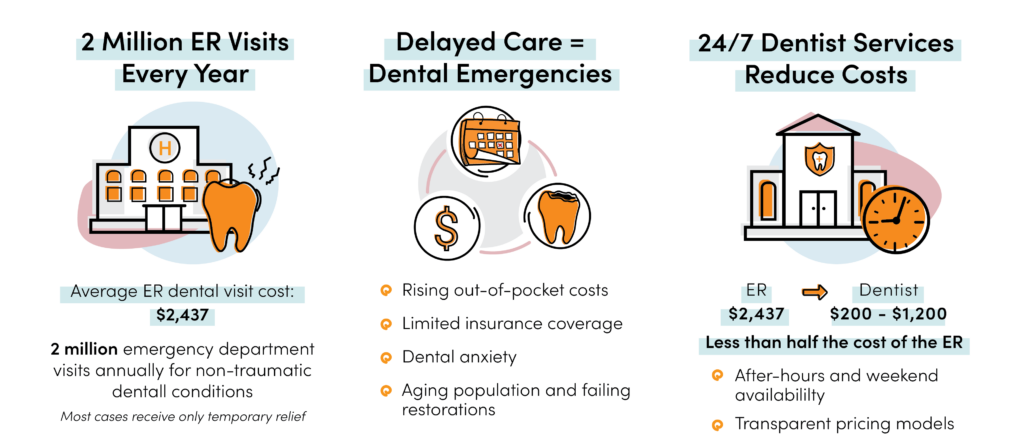
Non-traumatic dental conditions are usually caused by patients delaying routine care. Whether it’s dental anxiety, the rising cost of living, or lack of proper insurance, many people will choose to ignore early signs of dental problems or completely forgo treatment.
This behavior often mirrors broader shifts in the healthcare landscape. When access to preventive settings is restricted — whether through rising out-of-pocket costs or changes in state-level benefit structures — the hospital emergency department becomes the default fallback for pain management. Rather than receiving a permanent fix, patients enter a cycle of “stabilization” in which they receive temporary relief but no resolution of their problems.
An aging population is also a factor, as complex dental work (like implants or crowns) can fail unexpectedly.
How Can Emergency Dentist Services Help?
First of all, dental clinics with 24/7 online booking and weekend availability make dental services more accessible. Treatment can start right away, unlike a visit to the ER, where doctors will do their best to stabilize you but won’t address the underlying dental issue.
After-hours and weekend dentists are increasingly adopting transparent pricing and membership plans to bypass the insurance mess. They help by offering a direct-to-consumer model that functions like a retail clinic, making it easier for a patient to get a fixed price for a fixed problem on a Saturday night.
The dentist’s goal will be to resolve pain, prevent or address infection, and possibly to preserve affected teeth. He/she will assess the area and likely take x-rays to enable visualization of regions within and under teeth. There are germs that like to eat the same foods as we do, which can live within or around our teeth. After eating they release acidic waste products that can eat through and soften teeth (causing a cavity or decay) or eat through the gums and bone that surround and support them.
It may be possible to resolve pain by removing the germs and the associated contamination. The cleaning of contaminated inner nerve canals (referred to as pulpal debridement) can arrest tooth pain, and the sealing of the canals (referred to as root canal therapy, intended to prevent re-contamination, which may not need to be performed until a later visit) is a technique for preserving teeth with inner problems. Cleaning teeth above and below their supporting gums and bone (referred to as scaling and root planning) is a technique for preserving them when problems are located in their supporting structures.
Even for an uninsured patient paying out of pocket, the dentist is significantly cheaper. For the state/taxpayer, a dentist visit is 75%-80% less costly than an ER visit. On average, a localized emergency visit plus an extraction costs $200–$1,200 and prevents the problem from turning into a $50,000 multi-day hospital stay.
The cost, in terms of time, appointments, and money, may not outweigh the risk of attempting to preserve teeth, and tooth removal (extraction) may instead be considered. A dentist can discuss with you techniques to minimize your discomfort (e.g., local anesthetic injections) and anxiety. Among the options for reducing stress are nitrous oxide, which is a gas that can inhaled and enable people to be aware of but not as attentive to their surroundings (similar to how we feel upon waking in the morning), sedative pills, or medications that enable one to sleep during treatment are all options that can be considered.
Emergency Dental Care as a Necessity
With more dental patients crowding EDs across the country, it’s clear that emergency dental services are a necessity. After-hours and weekend clinics help patients in need, increase trust in the industry, and help reduce costs for individuals and hospitals alike.
About Dr. Richard Wilson, DDS
About Dr. Richard Wilson, DDS