
Presión en el seno versus dolor de muelas: cómo distinguir la diferencia

Reviewed By Dr. Kirti Chopra, DDS, FAGD
August 2026 • 5 min Read
Revisado por la Dra. Kirti Chopra, DDS, FAGD
August 2026 • 5 min Read
El dolor en los dientes superiores puede ser muy confuso. De un momento a otro parece una dolor de dientes; del siguiente, parece que toda la cara está bajo presión. Si has estado congestionado, enfermo o sufriendo de alergias, puede ser difícil saber si necesitas un dentista o un médico.
This guide breaks down the key differences between a sinus infection and a true dental problem, using simple self-checks you can do right now. It also tells you exactly who to call next, so you don’t lose time or let a small problem turn into a bigger one.
Why Sinus Infections Can Feel Like Tooth Pain
Your maxillary sinuses sit directly above the roots of your upper back teeth (molars and premolars). When these sinuses become inflamed or infected, the pressure can press on nerves that connect to multiple teeth at once. The result is pain that feels like it is coming from your teeth, even though the teeth themselves may be healthy.
It can also work the other way. Because these roots sit so close to the sinus, an infected upper back tooth, even one that has already had a root canal, can spread infection into the sinus. This kind of sinus infection often causes little or no tooth pain, so recurring sinus symptoms on one side, or symptoms that don’t clear up with sinus treatment, are a reason to have your upper teeth checked.
This overlap is why searches for “sinus infection vs. toothache” are so common, and why self-diagnosis is tricky. The self-checks below can point you in the right direction, but only an exam can confirm the cause.
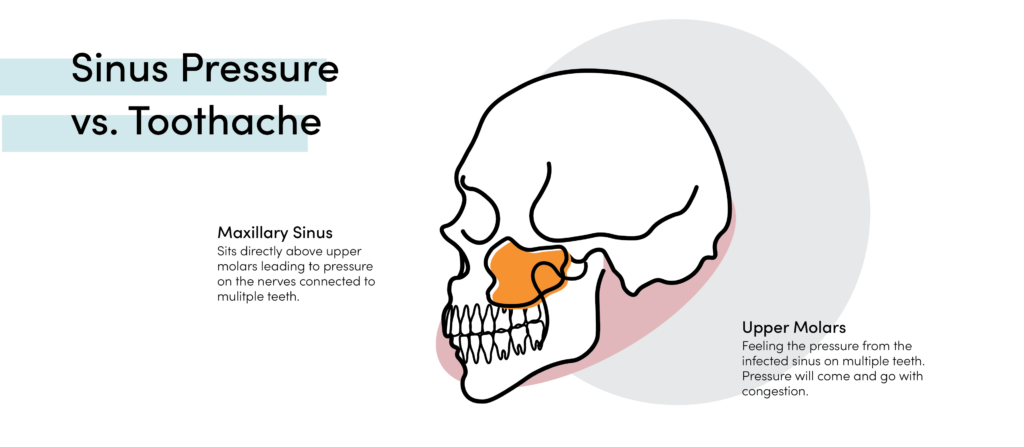
The Big Clue Most People Miss: One Tooth vs. Many
This is one of the most reliable differences.
Sinus-related tooth pain usually:
- Affects several upper teeth at once
- Feels spread out or hard to pinpoint
- Comes and goes with congestion or head position
Dental tooth pain usually:
- Centers on one specific tooth
- Is easy to point to with your finger
If you cannot identify a single “bad” tooth, sinus pressure becomes more likely, but it isn’t certain: pain from an inflamed tooth nerve can be hard to pinpoint and can seem to come from other teeth.
The Pain Quality Test: Pressure vs. Nerve Pain
The type of pain matters as much as the location.
Sinus infection pain often feels like:
- Dull, heavy pressure
- A deep ache behind the cheeks or eyes
- Fullness rather than sharp pain
Tooth infection or nerve pain often feels like:
- Sharp, stabbing pain
- Throbbing that keeps you awake
- Sudden jolts when biting or chewing
If the pain feels electric, sharp, or pulsing, that points toward a dental issue rather than sinusitis.
Haga clic en aquí o llame (888) 597-3896 para encontrar un dentista cerca de ti.
The Movement Test That Tells You a Lot
This quick check can add a clue, but it can’t tell sinusitis and a tooth infection apart on its own.
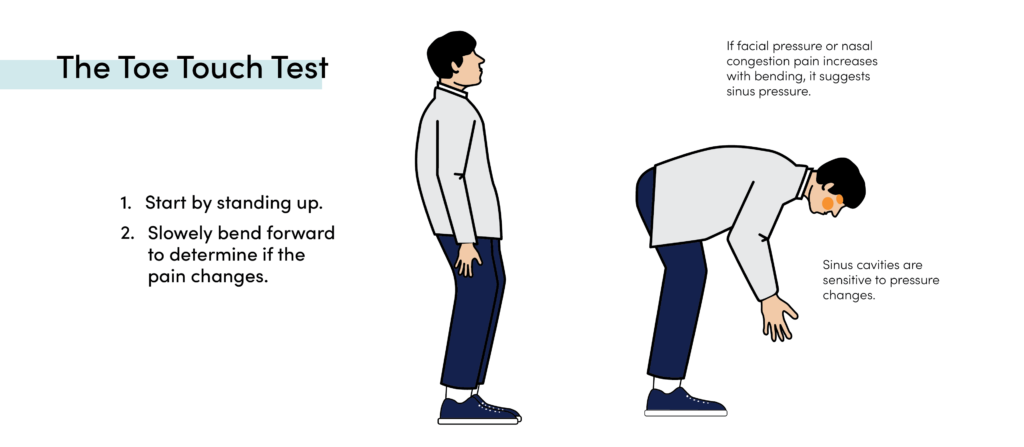
The Toe Touch Test
Stand up and slowly bend forward to touch your toes. Hold for a few seconds.
What the results mean:
- If the pain increases when you bend forward, sinus pressure is more likely, though a badly inflamed tooth can also hurt more when you bend over or lie down.
- If movement does not change the pain, a dental cause becomes more likely.
Other Symptoms That Tip the Scale
Signs it is likely a sinus infection:
- Nasal congestion or thick discharge
- Facial pressure or headache
- A changed sense of smell
- Recent cold, flu, or allergies
- Fatigue or a heavy head feeling
Signs It Is Likely a Tooth Problem:
- Sensitivity to hot or cold
- Pain when biting on one particular tooth
- Swollen gums near one tooth
- A bad taste or odor in the mouth
- Pain that wakes you up at night
A sinus infection may make your teeth ache, but it will not usually cause sharp temperature sensitivity or gum swelling around a single tooth.
Can Decongestants Help You Diagnose?
Sometimes, yes. If a decongestant or steam inhalation noticeably reduces your tooth pain within a few hours, that points toward sinus-related pain, but it isn’t proof: some sinus medicines also contain a pain reliever, such as ibuprofen, that can dull a toothache too. And if a decongestant doesn’t help, that doesn’t rule out your sinuses; the FDA has proposed removing oral phenylephrine, a common decongestant ingredient, because its review found it doesn’t relieve congestion.
This is not a cure, but it can be a helpful clue. If you try a decongestant, check the label first. Ask a doctor before using one if you have heart disease, high blood pressure, thyroid disease, diabetes, or trouble urinating due to an enlarged prostate, and don’t use one if you take a prescription MAOI (certain medicines for depression or Parkinson’s disease) or stopped one in the past 2 weeks.
Who Should You Call First? A Simple Decision Guide
Use this as your next-step logic.
| Call a doctor or urgent care if: | Call a dentist if: |
|---|---|
| Pain affects several upper teeth and comes with sinus symptoms such as congestion, thick nasal discharge, facial pressure, or sinus headaches, especially if it gets worse when you bend over | Pain is focused on one tooth; you feel sharp or throbbing pain; hot or cold makes it worse; you notice swelling, sensitivity, or a missing filling; sinus symptoms on one side keep coming back or don’t clear up with treatment |
Most sinus infections are caused by viruses and get better without antibiotics. See a doctor if your symptoms are severe (such as a severe headache or facial pain), get worse after improving, last more than 10 days without getting better, or come with a fever that lasts more than 3–4 days. Also see a doctor if you’ve had multiple sinus infections in the past year.
If you are unsure:
Seeing a dentist first is often the safest move. A dentist can examine your teeth and take X-rays (or a 3D scan if needed) to check for decay or infection, and confirm whether your teeth are actually the source of the pain. This prevents dangerous delays if a hidden dental infection is present.
Until you’re seen, an over-the-counter pain reliever such as ibuprofen or acetaminophen, if it’s safe for you and taken as the label directs, may ease the pain. If you’re also taking a sinus or cold medicine, check its label so you don’t take the same pain reliever twice. If the pain doesn’t go away with painkillers, see a dentist.
When Tooth Pain Is an Emergency
Do not wait if you have:
- Severe or worsening pain
- Facial swelling
- Fever along with tooth pain
- Pain that does not improve after a few days
These symptoms require prompt professional evaluation.
Your Next Step if You Are Still Unsure
Sinus pain and tooth pain can feel nearly identical, but the treatment paths are very different. Guessing wrong can cost you time, money, and comfort.
If you cannot confidently rule out a dental cause, an in-person dental exam is the best way to protect yourself. Dentistry.com connects you with local dentists who can evaluate your pain, take X-rays, and give you clear answers, often the same day.
Find a dentist near you and get clarity before the pain gets worse. Haga clic en aquí o llame (888) 597-3896 para encontrar un dentista cerca de ti.
Acerca de Dr. Kirti Chopra, DDS, FAGD
La Dra. Kirti Chopra es la fundadora y directora dental de Smile Design Studio by KC en Rittenhouse Square de Filadelfia, donde es conocida por su enfoque conservador y centrado en el paciente. Se toma el tiempo para escuchar las preocupaciones de cada paciente, explica claramente las opciones de tratamiento e involucra a los pacientes en todas las decisiones, para que su atención sea personalizada y libre de juicio. Graduada de la Facultad de Odontología de la Universidad de Indiana, obtuvo la máxima calificación en su clase y fue admitida en la Sociedad Nacional de Honor de Odontología Omicron Kappa Upsilon.
Ha completado más de 900 horas de formación continua en odontología estética, restauradora y integral, incluyendo Invisalign, rehabilitación completa de la boca, restauraciones Bioclear y diseño digital de sonrisa. También se graduó con honores del prestigioso Kois Center. Es miembro de la Academia de Odontología General y ha aprobado el examen escrito de acreditación de la AACD. Además, es miembro activo de la American Dental Association, la American Academy of Cosmetic Dentistry y la Pennsylvania Dental Association.
Fuentes:
- American Association of Endodontists. Maxillary sinusitis of endodontic origin: AAE position statement. April 2018.
- Carrasco-Labra A, et al. Evidence-based clinical practice guideline for the pharmacologic management of acute dental pain in adolescents, adults, and older adults. J Am Dent Assoc. 2024;155(2):102-117.e9. doi:10.1016/j.adaj.2023.10.009
- Centers for Disease Control and Prevention. Sinus infection basics.
- Glickman GN, Schweitzer JL. Endodontic diagnosis. Endodontics: Colleagues for Excellence. American Association of Endodontists; Fall 2013.
- Mayo Clinic. Acute sinusitis: Diagnosis and treatment.
- Mayo Clinic. Acute sinusitis: Symptoms and causes.
- Mayo Clinic. Tooth abscess: Symptoms and causes.
- Merck Manual Professional Version. Some causes of toothache (table).
- Toothache.
- S. Food and Drug Administration. Key information about nonprescription, over-the-counter (OTC) oral phenylephrine. November 2024.
- S. Biblioteca Nacional de Medicina, DailyMed. Advil Sinus Congestion and Pain Relief (ibuprofen and phenylephrine HCl) tablet, Drug Facts label.
- S. National Library of Medicine, DailyMed. Pseudoephedrine hydrochloride 60 mg tablet (Major Pharmaceuticals), Drug Facts label.
¿Necesita ayuda para encontrar un dentista?
Información relacionada

Planes de pago para dentistas: cómo financiar trabajos de emergencia
Las emergencias dentales rara vez vienen precedidas de advertencias. Una caries, un absceso o una corona fallida pueden convertirse en una factura de cuatro cifras en cuestión de horas. Cuando uno siente dolor, el estrés de encontrar la forma de pagarla puede ser tan abrumador como el propio problema dental.
Retainer permanente roto: ¿Es una emergencia dental?
Si bien un retenedor unido roto rara vez representa una emergencia médica, es recomendable programar una cita con el dentista para evitar molestias y movimientos dentales. La mayoría de los dentistas suelen poder resolver el problema con una sencilla restauración con adhesivo.

Costo del dentista de emergencia sin seguro: precios y soluciones económicas
El primer paso para aliviar el dolor dental agudo es una consulta odontológica de emergencia. Sin seguro médico, esto suele costar entre $100 y $300 dólares.
Esta cita permitirá el tratamiento inmediato del dolor. Si es necesario, usted y el equipo dental podrán planificar un tratamiento adicional y discutir formas de reducir el costo a lo largo del tiempo.