What Happens If You Pull the Tooth and Leave the Space Empty?
You can have a tooth extracted without immediately replacing it, but leaving the space empty can have consequences.
- Your teeth work as a system. When one disappears, neighboring teeth can gradually shift toward the open space, potentially changing your bite and affecting how you chew.
- The bone in the area also changes after a tooth is removed. Without the natural tooth and root present, the jawbone around the extraction site can lose volume over time.
That doesn’t mean every extracted tooth must be replaced in exactly the same way. Wisdom teeth, for example, generally aren’t replaced. If your dentist recommends removing a tooth you normally use for chewing or that affects your smile, ask what leaving the space empty would mean specifically for you.
The Time Commitment Most Cost Comparisons Leave Out
Money isn’t the only cost to consider; there’s also your time.
- A root canal usually takes one or two appointments, with another visit sometimes needed to finish restoring the tooth.
- An extraction itself may take only one appointment, but if you’re replacing the missing tooth, the process doesn’t necessarily end there. An implant, for example, requires additional treatment and healing before the final replacement tooth is complete. Depending on your situation, you may also need bone grafting or other preparatory procedures.
So when comparing tooth extraction vs. root canal, ask about the entire treatment timeline, not just how long it takes to address the painful tooth today.
Root Canal vs. Extraction: The Pros and Cons
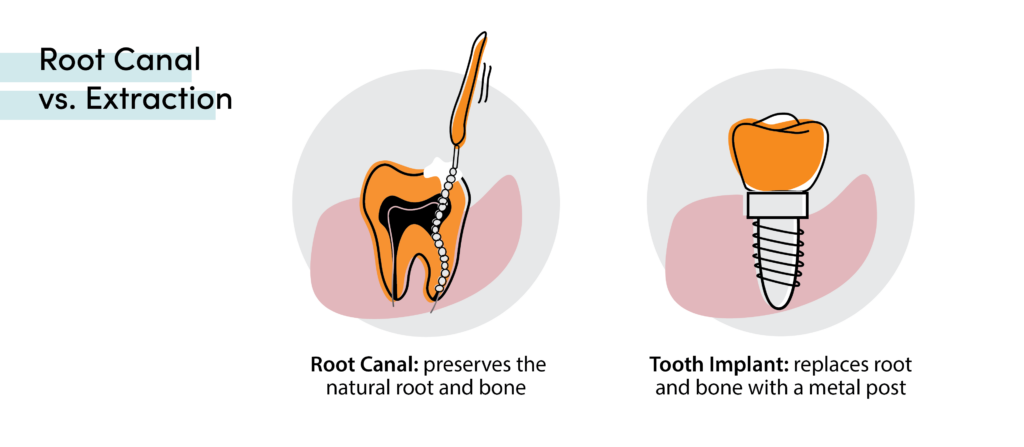
A root canal preserves your natural tooth, maintains the existing space in your bite, and can avoid the need for a replacement tooth. The tradeoff is a higher upfront cost, and the tooth often needs a crown or other restoration afterward.
Extraction removes the damaged tooth completely and usually costs less initially. It may also be the right choice when a tooth simply cannot be restored. However, once the tooth is gone, it cannot be put back, and replacing it can mean additional procedures, appointments, and costs.
Neither option is automatically right for every tooth. The important question is whether the tooth has a good enough long-term outlook to make saving it worthwhile.
Five Questions to Ask Your Dentist Before Deciding
If you’re unsure whether to choose a root canal or extraction, don’t feel like you need to decide based only on the price you’re quoted.
Ask your dentist:
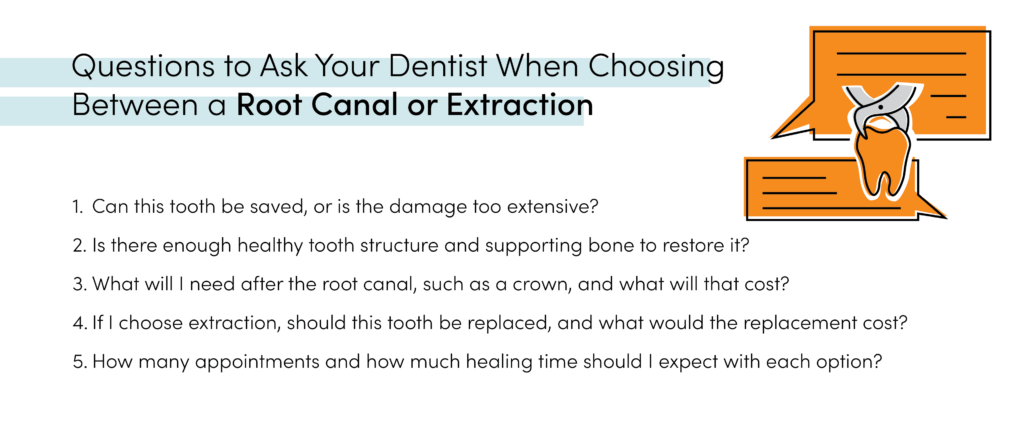
- Can this tooth be saved, or is the damage too extensive?
- Is there enough healthy tooth structure and supporting bone to restore it?
- What will I need after the root canal, such as a crown, and what will that cost?
- If I choose extraction, should this tooth be replaced, and what would the replacement cost?
- How many appointments and how much healing time should I expect with each option?
These questions give you a much clearer comparison of the two paths than simply asking which procedure is cheaper.
If cost is your biggest concern, ask the office for an estimate for the complete treatment, including the crown after a root canal or the likely replacement after an extraction. You can also ask about insurance coverage, payment plans, and whether treatment can be staged.
When Extraction Is the Better Choice
Saving your natural tooth is usually preferred, but sometimes a badly damaged tooth isn’t worth the cost or effort to save.
Extraction may make more sense when a tooth is fractured in a way that cannot be repaired, there isn’t enough healthy structure left to support a restoration, or the surrounding tissues cannot adequately support the tooth.
That’s why “save the tooth whenever possible” doesn’t mean “save every tooth at any cost.” The goal is to choose the treatment that gives you the strongest long-term result for your particular tooth.
How Dentistry.com Helps When You’re Deciding
You can’t determine whether a badly damaged tooth can be saved by looking at it in the mirror or describing your symptoms online. A dentist needs to examine the tooth in person, evaluate the remaining tooth structure and surrounding tissues, and usually take X-rays before recommending a root canal or extraction.
Dentistry.com can connect you with a local dentist for an in-person evaluation so you can understand whether your tooth can be saved, what each treatment would involve, and the costs to consider before deciding.
Tu siguiente paso
If you’re deciding between a root canal and extraction, don’t base the choice on fear of pain or the price of the first procedure alone. A root canal may cost more upfront, but it preserves your natural tooth. An extraction may cost less today, but replacing the missing tooth can add appointments, procedures, and expenses later.
The right choice depends on whether a dentist says that your tooth can be successfully restored and what each option means for your mouth over the long term.
Get the information you need to make the decision. Haga clic en aquí o llame (888) 597-3896 para encontrar un dentista cerca de ti.
Sobre la Dra. Jody Bardash, DMD
Sobre la Dra. Jody Bardash, DMD
La Dra. Jody Bardash es una clínica médica principal en Profesionales dentales de Fair Lawn, un consultorio de odontología familiar y cosmética en Fair Lawn, Nueva Jersey. Con más de 30 años de experiencia, se compromete a brindar atención médica compasiva y de alta calidad en odontología y estética facial.
Doctor Bardash, graduado del Instituto Isaac Brauer de la Universidad Yeshiva, se mantiene a la vanguardia de la innovación a través de una formación clínica avanzada y la educación continua. Es miembro de la AACD, ADA, AGD, American Academy of Facial Esthetics y la American Society for Dental Aesthetics. También es profesor clínico en el Centro Médico de la Universidad de Hackensack y en el Hospital de Englewood y ha sido reconocido por el Consejo de Investigación de los Consumidores de América durante 25 años como uno de los mejores dentistas y injertistas faciales de los Estados Unidos.